Mandatory time registration in Belgium from 2027: how to prepare.

From 1 January 2027, time registration is mandatory for every employer in Belgium. Today the obligation only applies in specific cases, such as part-time employees on a variable schedule or flexible working hours. Soon it applies to everyone.
For companies with several sites, shifts or people on the road, this is not a formality. If you work with spreadsheets or standalone time clocks today, you will need a system by 2027 that records the start, end and breaks of every working day and keeps them verifiable. This post covers what changes, what is still open and how to set up time registration in Odoo.
What changes on 1 January 2027?
In its budget agreement of November 2025, the federal government decided that registering working time becomes mandatory for all employers and all employees. It concerns daily working time: when someone starts, when they stop and which rest periods they take.
A time clock is not required. The government asks for a way to measure working time, and the choice of system is up to the employer. The aim is to enforce the rules on working and rest time, such as maximum working hours and overtime.
14 May 2019: CCOO ruling: member states must require a time registration system.
19 December 2024: Loredas ruling: the obligation applies to all employees.
November 2025: Budget agreement: Belgium makes time registration mandatory.
1 January 2027: Planned start for all employers.
Where does the obligation come from?
The rule follows from the European Working Time Directive (2003/88/EC). In the CCOO ruling of 14 May 2019, the Court of Justice of the European Union held that member states must require employers to use an objective, reliable and accessible system to measure daily working time. In the Loredas ruling of 19 December 2024, the Court confirmed that this applies to all employees, including domestic workers. Belgium is now turning that case law into legislation.
What is still open?
The details are not settled yet. At the time of writing, a draft text is with the National Labour Council, and parliament still has to pass the law and publish it in the Belgian Official Gazette. Open points include exactly which data you register, how long you keep it, which exceptions apply and which sanctions follow.
That is no reason to wait. What the Court asks for is settled: a system that is objective, reliable and accessible. If you set it up on that basis now, you only adjust the details in 2027.
Objective, reliable and accessible: what does that mean in practice?
In practice it comes down to three questions you can ask about your current registration.
Objective.
The registration shows the hours actually worked, not the theoretical schedule. Start, end and breaks are recorded when they happen, not filled in on Friday afterwards.
Reliable.
A correction is possible, but it leaves a trail: who changed what, when and why. A spreadsheet that anyone can edit struggles to meet that standard.
Accessible.
Employees can consult their own data. During an inspection, you pull the records per person and per period without days of searching.
How time registration works in Odoo.
Odoo Attendances records check-ins and check-outs per employee, linked to their working schedule in Odoo Employees. Everything lands in one database, so planning, time off and payroll work with the same data.
Check in where the work happens.
On a kiosk at the entrance with a badge or PIN, in the browser or through the Odoo app on a smartphone. For every entry, Odoo stores the time and, if you enable it, the IP address and GPS location. Location data falls under the GDPR: document why you collect it and inform your employees.
Overtime with an approval.
Odoo calculates extra hours against the working schedule. You set a tolerance in minutes and choose whether a manager approves overtime. Approved extra hours can be deducted from a time off request.
Errors show up immediately.
A missed check-out stands out in the overview, filtered by department, manager or date. With automatic check-out, Odoo closes an open entry after a buffer you choose.
One source for payroll.
If you use Odoo Payroll, the recorded attendances can form the basis for the work entries in the payroll calculation. If you work with an external social secretariat, the flow of that data is a fixed point in the analysis.
Where do you start before 2027?
Map who registers time today and how, per site, per shift and per contract type.
Choose the right check-in point per group: kiosk, browser or mobile.
Set the rules for corrections and for approving overtime.
Test with one department or site before you switch the whole company.
Follow the final legal text and adjust as soon as the details are known.
Why Dynapps?
Dynapps is an Odoo Gold partner with 900+ customer references and 280+ Odoo experts across 13 offices. When we implement Odoo, we set up time registration as part of your HR and payroll processes, not as a standalone time clock. The data comes in once and you use it wherever you need it.
Frequently asked questions about mandatory time registration.
When does time registration become mandatory in Belgium?
The federal government plans the obligation from 1 January 2027, for all employers and all employees. It announced this in the budget agreement of November 2025. At the time of writing, the law has not yet been published in the Belgian Official Gazette, so the implementing rules can still change. Today a registration obligation only applies in specific cases, such as part-time employees on a variable schedule and flexible working hours.
Is a time clock required from 2027?
No. The government asks for a system that measures working time in an objective, reliable and accessible way, not for a specific device. A digital time clock, a kiosk with a badge, registration in the browser or a smartphone app can all work, as long as start, end and breaks are recorded when they happen and corrections leave a trail. A spreadsheet filled in afterwards struggles to meet that standard.
Does the obligation also apply to small companies and remote workers?
Yes. The plans cover all employers, with no minimum number of employees. In the Loredas ruling of 19 December 2024, the Court of Justice confirmed that the obligation applies to all employees. People working from home or on the road also register their working time. In Odoo they do that through the browser or the mobile app, with GPS location if you enable it and inform your employees.
Which data do you need to register?
At least the daily working time per employee: when someone starts, when they stop and which breaks they take. This allows a check on maximum working hours, rest periods and overtime. The law still has to define exactly which data is required and how long you keep it. Choose a system in which you can adjust fields and retention periods without rebuilding everything.
How does time registration work in Odoo?
With Odoo Attendances, employees check in and out on a kiosk with a badge or PIN, in the browser or in the Odoo app. Odoo records the time and compares the registered hours with the working schedule. Extra hours are calculated and a manager can approve them. Because Attendances shares one database with Employees, Planning and Payroll, you reuse the data without entering it again.
What can you do now, before the law is final?
Start with an inventory: who registers time today and how, per site, per shift and per contract type. Then choose a check-in point per group and set the rules for corrections and overtime. A test in one department quickly shows where things get stuck. If you set up an objective, reliable and accessible system now, you only adjust the details once the final law is out.
Discover what Odoo can do for your business.
A first conversation to see if we fit, followed by a demo built around your processes.
More posts like this

6-minute read
Peppol mandatory, e-reporting from 2028: how to prepare.
Since 2026, e-invoicing via Peppol is mandatory in Belgium. From 2028, your invoice data goes to the tax authority in near real time. What that asks.

3-minute read
Interview with Leïla Chojnacki, Deputy CEO and CFO of the Obiz Group
3 min read
Odoo 19.4: What's new? Key features and essential takeaways
Odoo 19.4 (July 2026) is a quarterly update: connection to AI agents via MCP, voice interaction, editable margins, two-tier duplicate detection, stock aging report, and continuous production.

3 minute read
AI in Odoo: What are the requirements for enabling it?
The question "Do we have the right to use Odoo's AI?" often has a simpler answer than expected.

4 min read
Certified by Dynapps: bringing Odoo expertise to local SMEs in France
Dynapps France is rolling out the Certified by Dynapps label, a program that gives small and medium-sized businesses local Odoo expertise and gives independent consultants a structured way to grow around Odoo.
4 min read
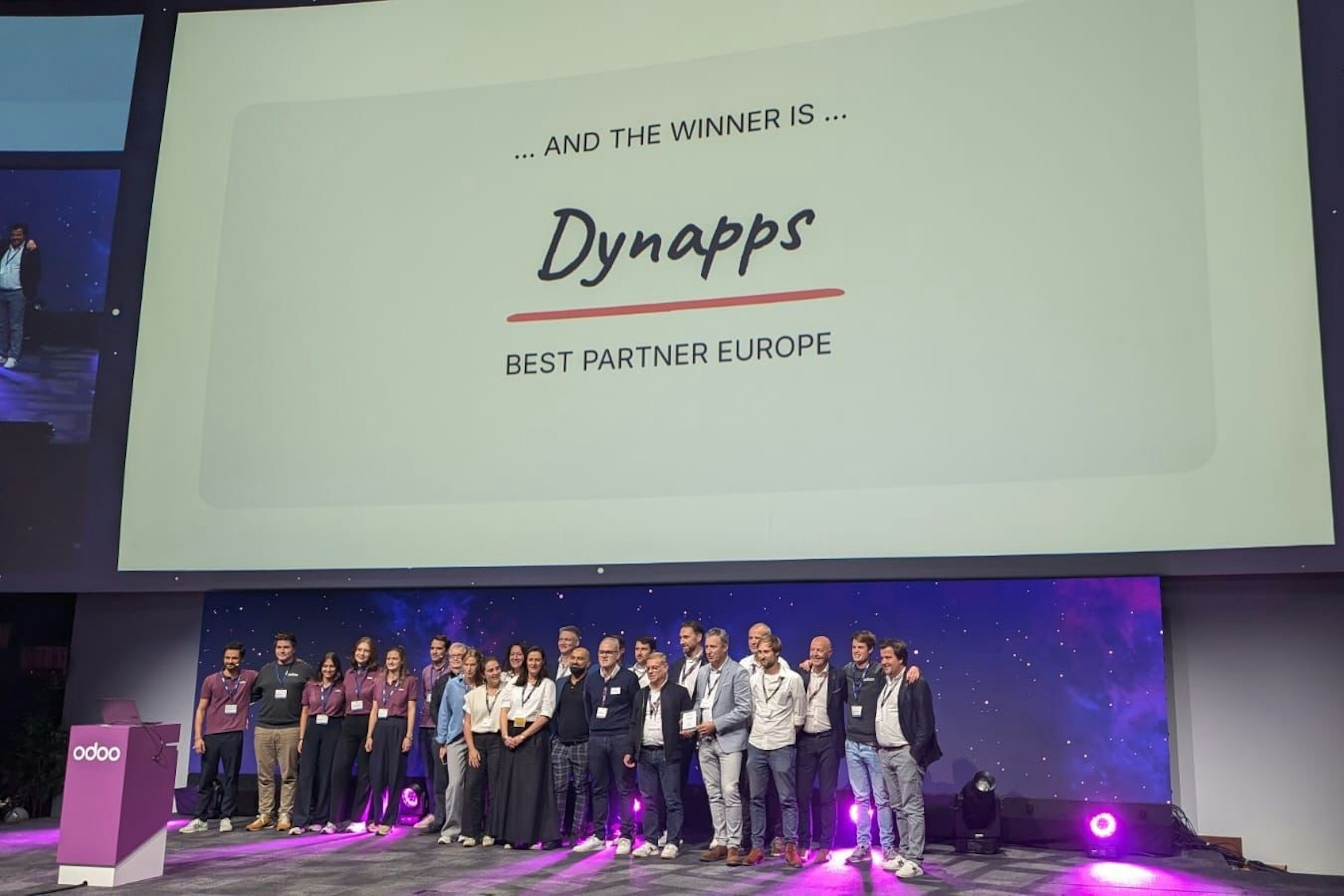
Dynapps named Best Odoo Partner in Europe
At the Odoo Experience Days in Brussels, Dynapps won the title of Best Odoo Implementation Partner in Europe, with former CEO Karel Hendrickx and the team collecting the award on 2–4 October 2024.
3 min read
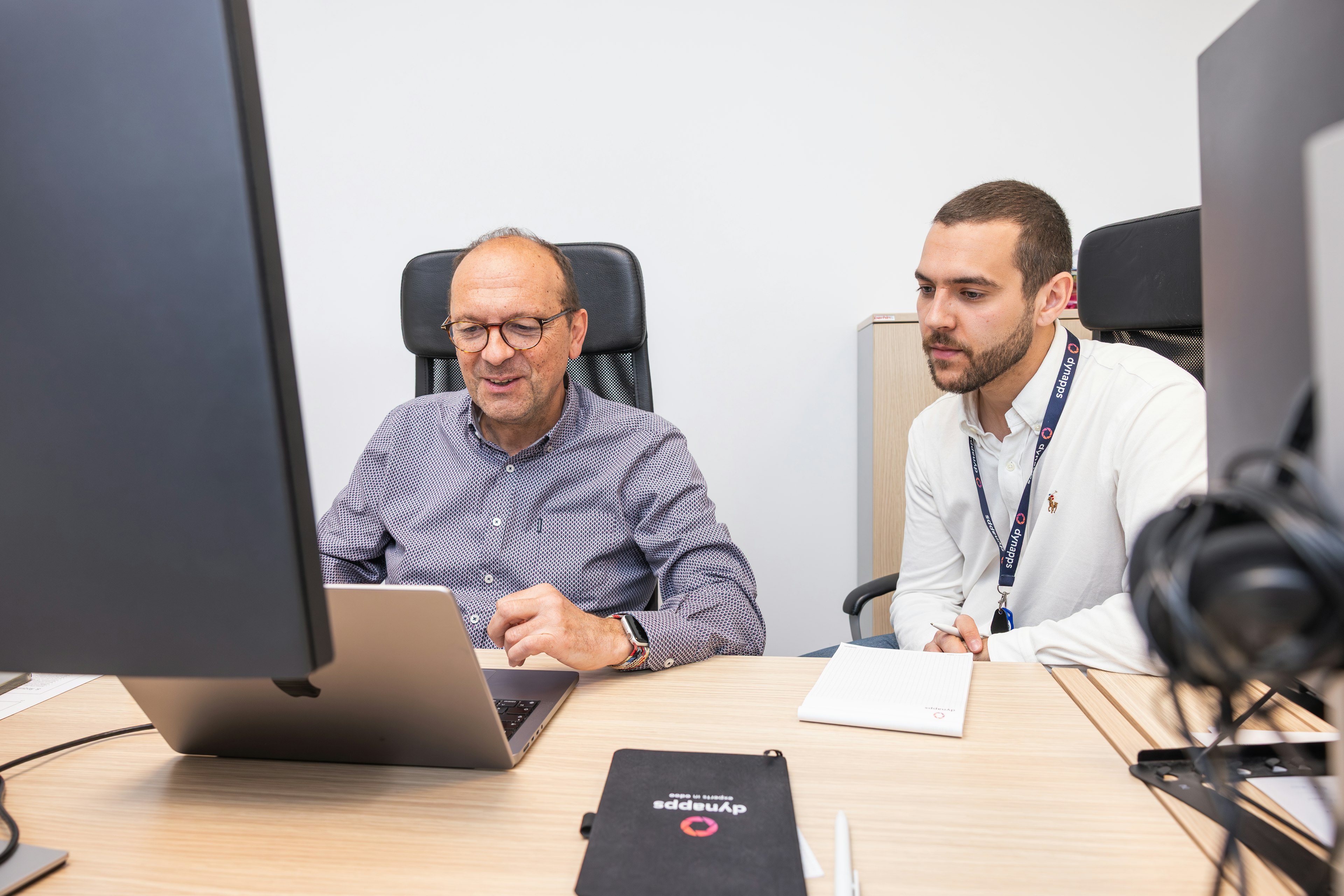
Dynapps recertified to ISO/IEC 27001:2022 with zero non-conformities
Dynapps holds the ISO/IEC 27001:2022 certificate for its information security management system across its Belgian and Dutch entities. The January 2026 recertification audit closed with zero non-conformities.
4 min read
ERP vs CRM: what is the difference?
In a competitive market, businesses lean on software to operate efficiently. Two systems come up most: ERP and CRM. They serve different purposes, and they often work better together than apart.
6 min read
Odoo or Exact: which ERP fits your SME?
Choosing an ERP changes how the business runs. Odoo and Exact both target SMEs, but they solve different problems. This is a side-by-side read on functionality, flexibility, support, and where each one fits.
4 min read
Odoo vs AFAS: comparing two ERP systems built for SMEs in NL and BE
A side-by-side comparison of Odoo and AFAS, two ERP systems built for SMEs in the Netherlands and Belgium. It weighs flexibility, user-friendliness, support, integrations and cost per system.