Mandatory time tracking for every Belgian employer.
From 1 January 2027, every Belgian employer must record working hours digitally. The measure was announced in the budget agreement of November 2025. One platform for clocking in, time tracking, payroll and planning: no standalone time clock, no Excel, no double entry.
What mandatory time tracking actually requires.
Mandatory time tracking means that every Belgian employer, private and public, records the start and end time per employee per day digitally from 1 January 2027, including breaks and overtime. There is no minimum company size, and office roles are covered too. Paper and Excel no longer suffice. An objective and reliable time tracking system does.
For every sector
Time tracking in every sector, no exceptions.
Manufacturing, construction, field services or office roles, small company or large SME: every Belgian employer with staff falls under the obligation. What mandatory time registration means per sector:
Construction
Field teams across multiple sites. Registration per site flows through to planning and project invoicing.
Manufacturing
Variable shifts, complex schedules. Clocking in links to work orders and cost tracking. No more Excel.
Retail
Branches, part-time contracts, peak hours. One system for planning, attendance and payroll.
Logistics
Drivers, warehouse staff, shift work. Time data flows through to transport planning and payroll.
Health & pharma
Strict schedules, GDP/GMP audit trail. Clocking in immediately provides the evidence for inspection.
Services
Consultants and technicians on client sites. Time registration links to project, invoicing and HR in one flow.
What you lose if you wait until Q4 2026.
Employers who already register digitally avoid a rushed implementation and gain operationally right away. Those who wait risk a labour inspection without an audit trail, and keep paying for avoidable errors in the meantime. The risks of waiting:
No audit trail during a labour inspection
Disputes over overtime or hours worked are hard to defend without objective records.
Payroll errors keep adding up
Manual Excel transfers and corrections cost HR hours every month and are expensive to detect.
Double entry across two systems
A standalone time clock alongside Odoo means reconciling again every month.
A rushed implementation in Q4 2026
Internal disruption, more errors, less time for proper onboarding of your team.

The module in Odoo
Odoo Attendances: time tracking software that works right away.
Odoo Attendances gives employees three ways to clock in and then keeps the record automatically. A full time tracking system for employee time tracking, planning and payroll, without a standalone time clock. It runs on tablet, smartphone and in the browser.
How employees clock in
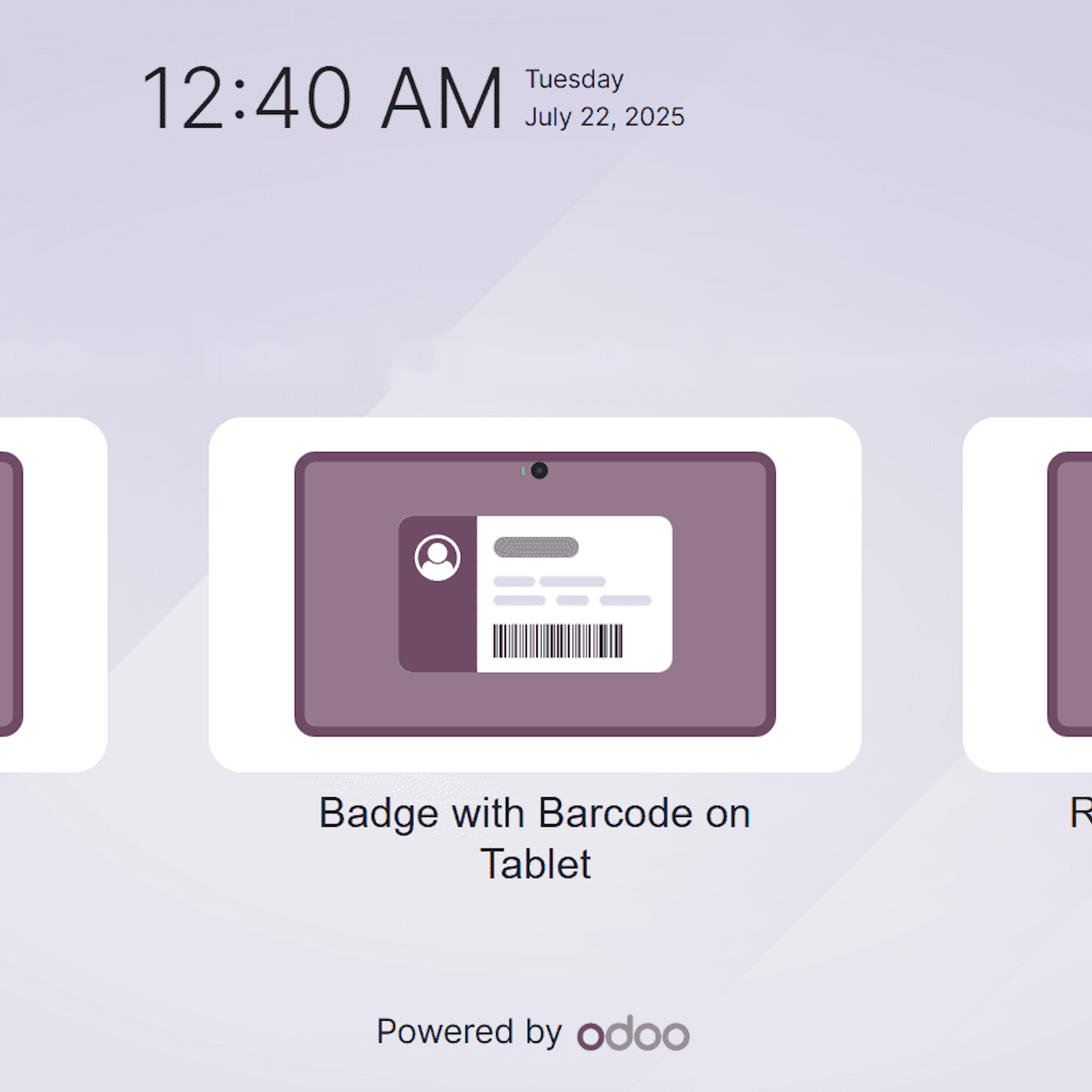
Kiosk mode: Tablet or fixed screen on site. Check in with a badge, PIN or manual entry.
Mobile app: For people on the road or working from home. Clock in via smartphone, with a timestamp and optional location.
Web interface: Office roles register straight from their Odoo browser session. No extra app.
What the system does automatically
Full audit trail: Every check-in stored tamper-proof, available for labour inspection.
Overtime detection: A signal when employees work longer than the schedule allows.
Absence sync: Leave, sickness and public holidays appear automatically in attendance.
Real-time reporting: Dashboards per employee or period, exportable for your social secretariat.
A digital time clock in 2027, or integrated software?
Is a time clock mandatory in 2027? No, the law requires an objective, reliable system, not a physical device. A standalone clock or app only records start and end times: someone still exports and reconciles the hours in payroll every month, with no link to planning or projects and leave tracked separately, a separate licence bolted onto your ERP.
Odoo Attendances works the other way around. Hours flow straight to payroll, planned shifts sit next to actual hours, leave and public holidays are handled automatically, and project hours link through to invoicing, with direct Partena integration from Odoo 20 onwards. One platform for compliance, payroll and planning instead of a patchwork of tools.
Why Dynapps
Why Dynapps as your Odoo partner
We are the largest Odoo implementation partner in Europe, with teams in Belgium, the Netherlands, France, Switzerland and Spain. We work as an Odoo Gold Partner and we are ISO 27001 certified. In 2024, the Odoo Experience Days named us Best Odoo Implementation Partner in Europe. What that means for you:
Local Odoo partner
Official Odoo partner in Belgium, with implementation and support in your language.
Industry experience
Consultants who know your sector: manufacturing, construction, logistics, retail, pharma and services.
One point of contact
From configuration to training. The people who scope your project also build it.
We stay after go-live
Support from the same team, and the move to the next Odoo release.
Get ready for time registration 2027.
The Belgian government confirmed 1 January 2027 as the target date. The measure was announced in the budget agreement of November 2025, and a parliamentary resolution was tabled in February 2026.
The law was announced in the budget agreement of November 2025 and a parliamentary resolution was tabled in February 2026. As of today (May 2026), the text has not yet been formally published in the Belgian Official Gazette. The direction, however, is clear and irreversible, with a target date of 1 January 2027.
Yes. There is no minimum company size. Every Belgian employer (private and public) must record the daily working hours of every employee digitally. Today, only 9.5% of SMEs with fewer than 10 employees use an electronic system. The large majority will need to act before 2027.
Yes. The system must cover all employees, regardless of where they work. Odoo supports mobile and web-based check-in for remote employees.
No. The law requires an objective, reliable and accessible system. Software, apps, kiosk tablets and badge systems all qualify. Paper and Excel are no longer enough.
A digital time clock is time tracking software that records working hours via a kiosk, mobile app or web interface, instead of a physical device. It runs on a tablet, smartphone or computer and stores all clock-in and clock-out times in an audit trail. Odoo Attendances is an example of an integrated digital time clock: the hours flow automatically to payroll and planning, without a manual step.
Odoo Attendances is the digital time tracking module that lets employees clock in and out via kiosk, mobile app or web. The module synchronises automatically with Odoo Payroll, Planning and Timesheets, and provides a full audit trail for labour inspection.
Odoo 20 adds a one-click timer in the top bar, an AI-driven timesheet assistant that makes suggestions based on your computer activity, and a native integration with Partena, the largest Belgian social secretariat.
Since July 2024, the rules around flexible working schedules are stricter: employers must record start and end times per employee per day and be able to show any overruns on request. A digital system like Odoo Attendances captures this automatically.
First map what you do today and where the gaps are. If you already use Odoo, Attendances is often already in your licence and only needs activating. If you still work with Excel or a standalone time clock, this is the moment to integrate everything properly, well before the deadline.