What is OpenERP, and why it is now Odoo.
If you are researching OpenERP, here is the short version: OpenERP is the old name for Odoo. It is an open-source ERP system that connects your core processes in one place. Since May 2014 it has been called Odoo. As an Odoo Gold Partner in Belgium, Dynapps implements it for companies that have outgrown their current systems.

What is OpenERP, and where did it come from?
OpenERP is an enterprise resource planning (ERP) system. It started as a low-cost, flexible alternative to the traditional ERP systems that were expensive and hard to adapt to smaller companies.
A Brief History of OpenERP: From Open-Source Software to a Full-Fledged ERP System.
The story began in 2005, when Fabien Pinckaers, its creator, decided to develop open-source ERP software to help small and medium-sized businesses manage their resources efficiently. Originally called TinyERP, the project was created with the goal of offering a more accessible tool for businesses without requiring them to invest large sums of money in proprietary software.
From TinyERP to OpenERP and then to Odoo: the project's evolution.
OpenERP ERP began as TinyERP in 2002, created by Fabien Pinckaers to help his father’s business, designed to be accessible and user-friendly. As TinyERP gained popularity, business needs became more complex, and the software began to evolve to include more modules and features. That is when the name was changed to OpenERP in 2005 to reflect its growth and its focus on offering a more comprehensive and robust solution.
However, in 2014, the project underwent another name change, this time to Odoo, to further reflect its comprehensive approach and its vision of going beyond a traditional ERP. This new name encompassed not only enterprise resource management but also other functionalities such as e-commerce, project management, and marketing automation.
Why did Odoo change its name starting with version 8?
The name change to Odoo was not just a cosmetic change, but a strategy to position the tool as a broader and more flexible platform. The Odoo version 8 marked a major milestone in its evolution, as the ERP solution began to include additional modules that enabled companies to manage more than just business resources.
This transformed Odoo into an all-in-one business management suite, rather than just an ERP system. Furthermore, the name Odoo—which comes from the phrase "On Demand Open Object"—highlights its ability to adapt dynamically and flexibly to the specific needs of each business.

What is an ERP, and how does OpenERP fit into that definition?
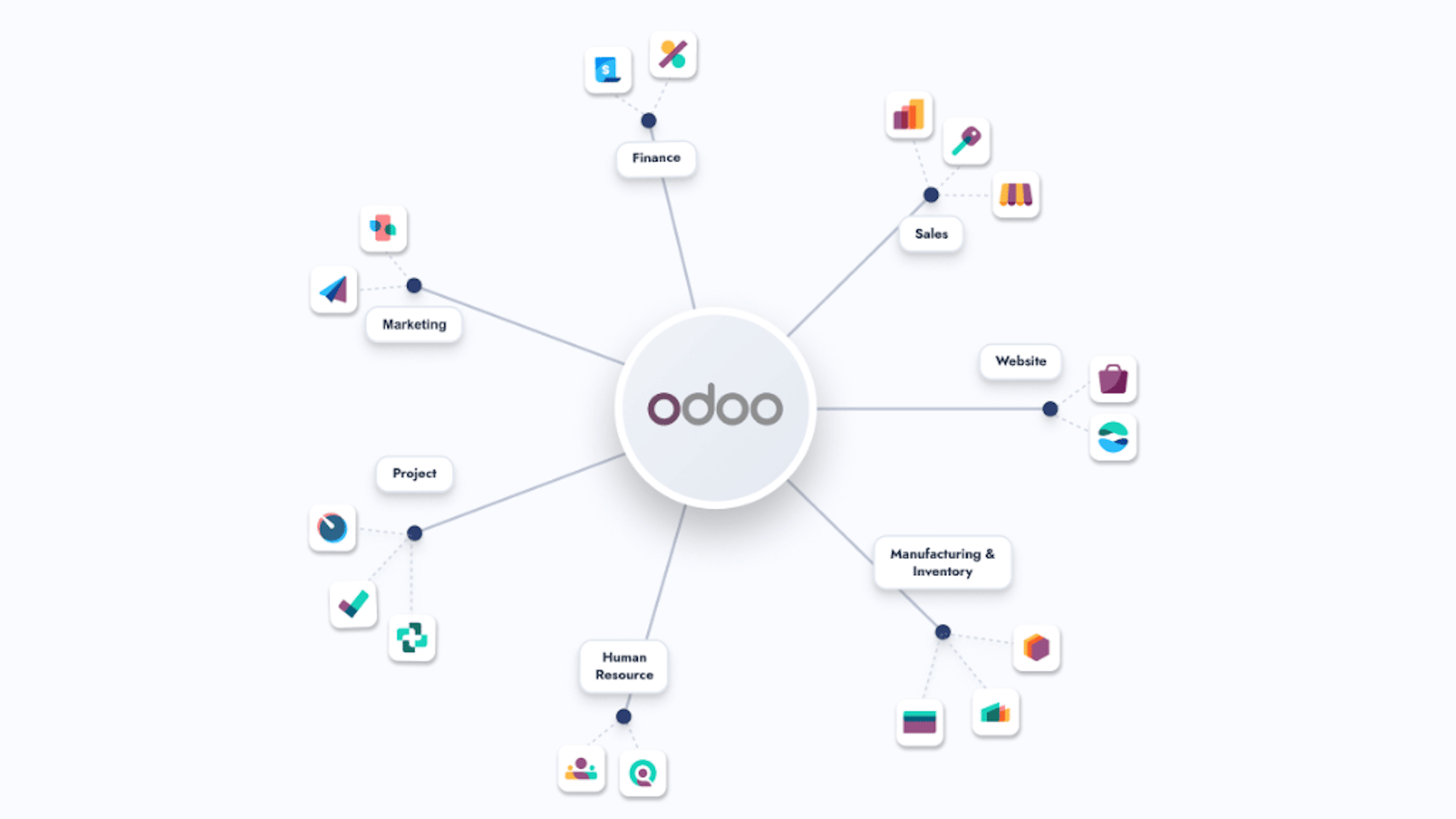
An ERP is one system that centralises and automates a company's core processes, giving you a single view of your data. OpenERP, now Odoo, fits that definition through a modular set of apps.
The modules that matter most for mid-market operations:
Inventory. Stock in real time, purchase and sales orders, optimised levels.
Sales and purchasing. Customer orders, invoicing, procurement, and supplier management.
Accounting. Financial accounting, payables and receivables, reporting.
HR. People, absences, and performance.
CRM. Leads, opportunities, and customer communication.
The point is not the modules on their own. It is that they talk to each other. A sale updates stock and lands in the accounts without anyone re-keying it. If you want the full picture, read why we choose Odoo.
Benefits of using an open-source ERP system like Odoo.
Lower entry cost
Odoo Community is open source and carries no licence fee. Odoo Enterprise is the paid edition, with more features and official support. Either way, you avoid the heavy upfront licences of traditional ERP. Your investment goes into implementation, support, and the parts you actually customise.
Flexibility and adaptability
Every company runs differently. With Odoo you can extend and adapt the system to your processes instead of forcing your processes into the software. That is the difference between a tool you tolerate and one your team actually uses.
Modular scalability
Part of the digital transformation with Odoo stems from the ability to scale modules according to business needs. Companies can start with essential modules and, as they grow, add additional ones. This scalability allows for a phased implementation, reducing risks and facilitating investment in long-term technology. This capability means that the ERP system supports the business from local expansion through to internationalization.
Active community and access to source code
Because Odoo is open source, a large community keeps improving it and building modules. Access to the source code means you are not locked to a single vendor for every change.
OpenERP versions still in use, and the risk of staying on them.
OpenERP 6 and 7 were widely used. Odoo 8 brought a big step up in usability and performance. Some companies still run the older versions, usually because of past investment or specific integrations.
Staying on an old version has a real cost. No security updates. No official support. New features and modules only land in current releases. Over time, that is not stability. It is exposure.
Is OpenERP still an option in 2026?
By 2026, most companies have moved to a current Odoo release. Today Odoo comes in two editions: Odoo Community (free, open source) and Odoo Enterprise (paid, with extra features and support). You pick the balance of cost and functionality that fits.
Some companies keep a legacy OpenERP version for compatibility or because they invested heavily in customisations. That can be a fair short-term call. But outdated software quietly limits you, and the gap only widens. Review it regularly.
How to migrate from OpenERP to a modern Odoo.
Migration works when it is planned, not rushed. The steps:
Audit the current system: which custom modules and integrations actually matter.
Design a migration plan with pilot tests and user training.
Verify every critical function is replicated before you switch.
This is work you want to do with a partner who has done it before. At Dynapps it is a service in its own right: recovering and migrating an Odoo environment that is stuck on an old version or a previous partner's work.
Discover what Odoo can do for your business.
An initial meeting to see if we're a good fit, followed by a demonstration tailored to your processes.
More posts like this

6-minute read
Peppol mandatory, e-reporting from 2028: how to prepare.
Since 2026, e-invoicing via Peppol is mandatory in Belgium. From 2028, your invoice data goes to the tax authority in near real time. What that asks.

3-minute read
Interview with Leïla Chojnacki, Deputy CEO and CFO of the Obiz Group
3 min read
Odoo 19.4: What's new? Key features and essential takeaways
Odoo 19.4 (July 2026) is a quarterly update: connection to AI agents via MCP, voice interaction, editable margins, two-tier duplicate detection, stock aging report, and continuous production.
3 minute read
AI in Odoo: What are the requirements for enabling it?
The question "Do we have the right to use Odoo's AI?" often has a simpler answer than expected.

4 min read
Certified by Dynapps: bringing Odoo expertise to local SMEs in France
Dynapps France is rolling out the Certified by Dynapps label, a program that gives small and medium-sized businesses local Odoo expertise and gives independent consultants a structured way to grow around Odoo.
4 min read
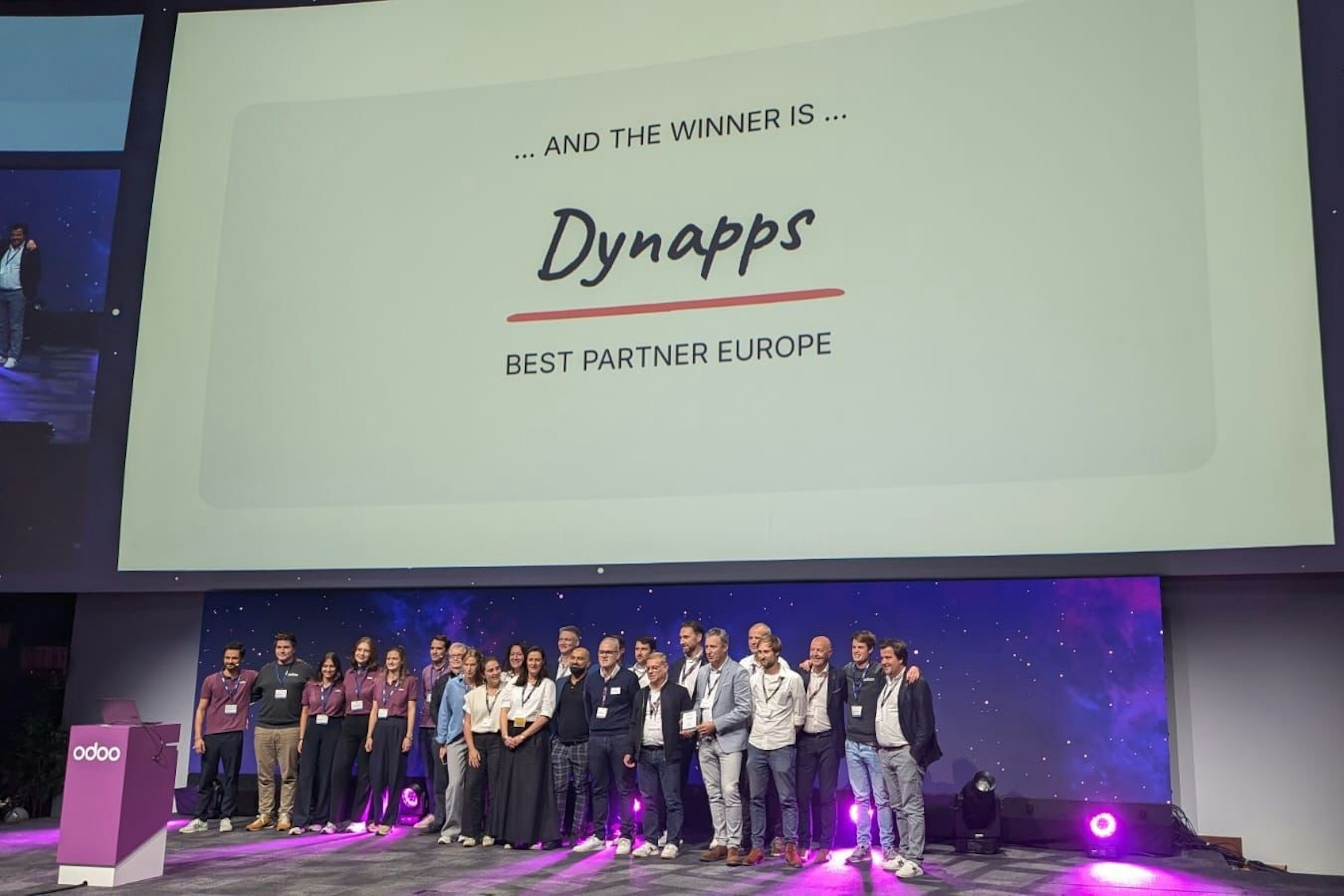
Dynapps named Best Odoo Partner in Europe
At the Odoo Experience Days in Brussels, Dynapps won the title of Best Odoo Implementation Partner in Europe, with former CEO Karel Hendrickx and the team collecting the award on 2–4 October 2024.
3 min read
Dynapps recertified to ISO/IEC 27001:2022 with zero non-conformities
Dynapps holds the ISO/IEC 27001:2022 certificate for its information security management system across its Belgian and Dutch entities. The January 2026 recertification audit closed with zero non-conformities.
4 min read
ERP vs CRM: what is the difference?
In a competitive market, businesses lean on software to operate efficiently. Two systems come up most: ERP and CRM. They serve different purposes, and they often work better together than apart.
6 min read
Odoo or Exact: which ERP fits your SME?
Choosing an ERP changes how the business runs. Odoo and Exact both target SMEs, but they solve different problems. This is a side-by-side read on functionality, flexibility, support, and where each one fits.
4 min read
Odoo vs AFAS: comparing two ERP systems built for SMEs in NL and BE
A side-by-side comparison of Odoo and AFAS, two ERP systems built for SMEs in the Netherlands and Belgium. It weighs flexibility, user-friendliness, support, integrations and cost per system.