Odoo or Exact: which ERP fits your SME?
Choosing an ERP changes how the business runs. Odoo and Exact both target SMEs, but they solve different problems. This is a side-by-side read on functionality, flexibility, support, and where each one fits.
Why is choosing an ERP a long-term decision?
Choosing an ERP is one of the bigger decisions a growing business makes. It ties together invoicing, inventory, sales, and finance into one backbone. Once it is in place, the way the company operates is shaped around it. That makes the choice worth the time. Do the research, prepare thoroughly, and talk to people who have implemented these systems before.
The ERP software market is crowded. Some systems target large multinationals. Others are built for SMEs. Odoo and Exact both sit in the SME segment, which is why they end up on the same shortlist. They are not interchangeable, though. Knowing where each one is strongest is what turns a shortlist into a decision.
Before comparing the two, it helps to be clear on what matters. Which data flows are you trying to manage? Which functionality do you need today, and which will you need in two years? How quickly can the team learn the interface? What does support look like after go-live? These four questions cut most of the noise.
Odoo and Exact: two different starting points
What is Odoo?
Odoo is a Belgian open-source ERP suite with over thirteen million users worldwide. It is modular: accounting, CRM, sales, inventory, manufacturing, HR, e-commerce, marketing, and website builder are separate apps that all share one database. You start with the modules you need and add more as the business grows. The interface is modern and approachable, which keeps onboarding shorter than most ERP projects.
What is Exact?
Exact is a Dutch software company founded in Delft more than forty years ago. It serves SMEs and accountants across the Netherlands, Belgium, and Germany. The core strength is accounting and financial process management, with extensions into project management, manufacturing, and trade. There are several deployment options, Exact Online, Exact Globe+, Synergy, Financials, depending on company size. More than 675,000 companies use Exact to manage finance and operations.
What does each system cover, side by side?
Both Odoo and Exact are built as connected modules. Each module handles a specific function, CRM, finance, inventory, project management, and together they form one database for the organisation. The lists below are the components each vendor markets as core. In practice both platforms ship with many more, and the question that matters is not how many modules exist, but which ones the business will actually use.
Odoo core modules
CRM: customer interaction, sales opportunities, reporting
Sales: quotes, orders, sales activity management
Purchasing: requests for quotation, purchase orders, supplier management
Inventory: real-time stock status
Project management: time tracking and cost management
Accounting: accounts receivable, accounts payable, full financial transactions
HRM: recruitment, payroll, leave
E-commerce: product management and online payments
Marketing: email, social, lead management
Website builder: site creation and management
Exact core components
Financial: accounting, financial management, budgeting, reporting
Purchasing: RFQs, purchase orders, supplier management
Inventory: real-time stock status
Manufacturing: production planning, control, quality management
Sales: quote management, order processing, invoicing
CRM: customer interaction and reporting
HRM: payroll, leave, talent management
Project management: time tracking and cost management
Service management: customer appointments and maintenance planning
Business intelligence: advanced analytics and reporting
Odoo's flexibility lets the system grow with the business, whether you start small or start big. You configure only the modules you need, and add more as the work changes.
— Nadia Roukes, Business Consultant at Dynapps
What are four real differences between Odoo and Exact?
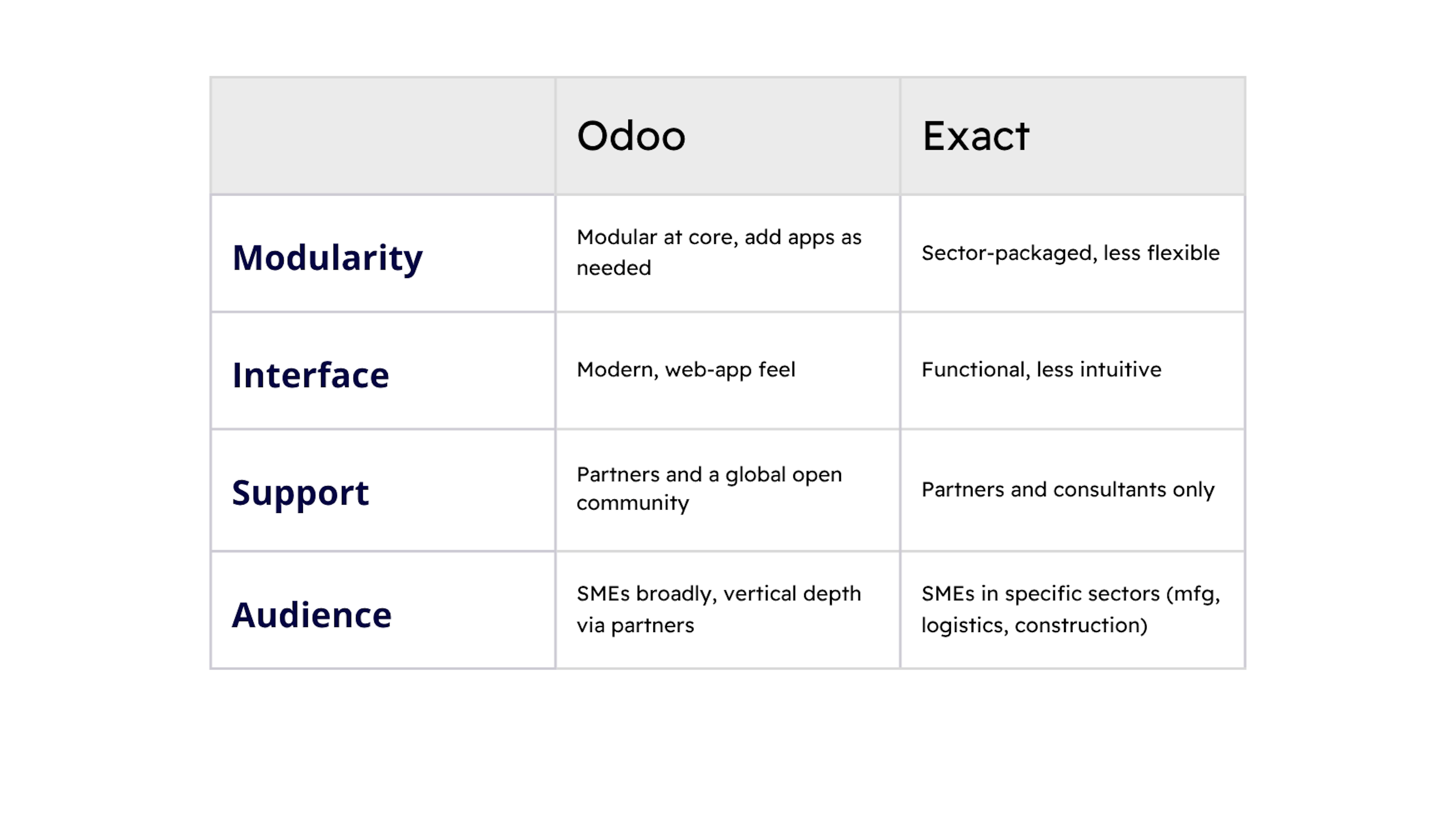
Odoo and Exact share a lot of surface area. Both ship modular ERP for SMEs, both run in the cloud, both cover finance, sales, inventory, and CRM. The differences show up once a business starts pushing the system. Four stand out: how modular each platform is, how the interface feels in daily use, what support looks like after go-live, and which kind of business each one was built for. Naming these four upfront is the fastest way to know whether Odoo or Exact is the better starting point for a given company.
Modularity and flexibility
Odoo is modular at its core. You activate the apps you need and add more later. Exact is less modular and offers solutions packaged for specific sectors like construction or manufacturing. That makes Exact a faster start for businesses that fit one of those sector packages, but leaves less room for tailoring when the fit is not exact.
User-friendliness
Odoo's interface is built around the same design patterns most teams already know from modern web applications. Exact is functional but less intuitive, particularly for non-technical users. For an SME without a dedicated IT team, the learning curve is the bigger hidden cost.
Support model
Odoo works through authorised partners like Dynapps, who provide both consultancy and ongoing support. On top of that, Odoo has a large international community active on forums and contributing modules. Exact provides professional support, but only through partners and consultants. There is no equivalent open community to fall back on.
Target audience
Exact targets specific sectors, with manufacturing, logistics, and construction the most developed. Odoo targets SMEs broadly, with vertical depth coming from partners. If a business sits squarely in one of Exact's sector packages, that focus helps. If it does not, Odoo's breadth is the safer bet.
Picked an ERP. Now the real work starts.
Choosing the system is the easy part. Implementation is where ERP projects either compound value or quietly drain it. A successful rollout depends on the right package, consultants who have done it before, internal buy-in, and a project plan that survives contact with reality. An implementation partner brings the knowledge, the experience, and the support to put the software into the business without breaking the business in the process. It is a partnership, not a delivery.
Whichever system the business chooses, the work after the contract is where the value gets made. Get the preparation right and the rest follows. Get it wrong and no software, modular or otherwise, will fix it.
See what Odoo could look like for your business.
A first conversation to see if there is a match, and a demo shaped around your processes.
More posts like this

3-minute read
Interview with Leïla Chojnacki, Deputy CEO and CFO of the Obiz Group
3 min read
Odoo 19.4: What's new? Key features and essential takeaways
Odoo 19.4 (July 2026) is a quarterly update: connection to AI agents via MCP, voice interaction, editable margins, two-tier duplicate detection, stock aging report, and continuous production.
3 minute read
AI in Odoo: What are the requirements for enabling it?
The question "Do we have the right to use Odoo's AI?" often has a simpler answer than expected.

4 min read
Certified by Dynapps: bringing Odoo expertise to local SMEs in France
Dynapps France is rolling out the Certified by Dynapps label, a program that gives small and medium-sized businesses local Odoo expertise and gives independent consultants a structured way to grow around Odoo.
4 min read
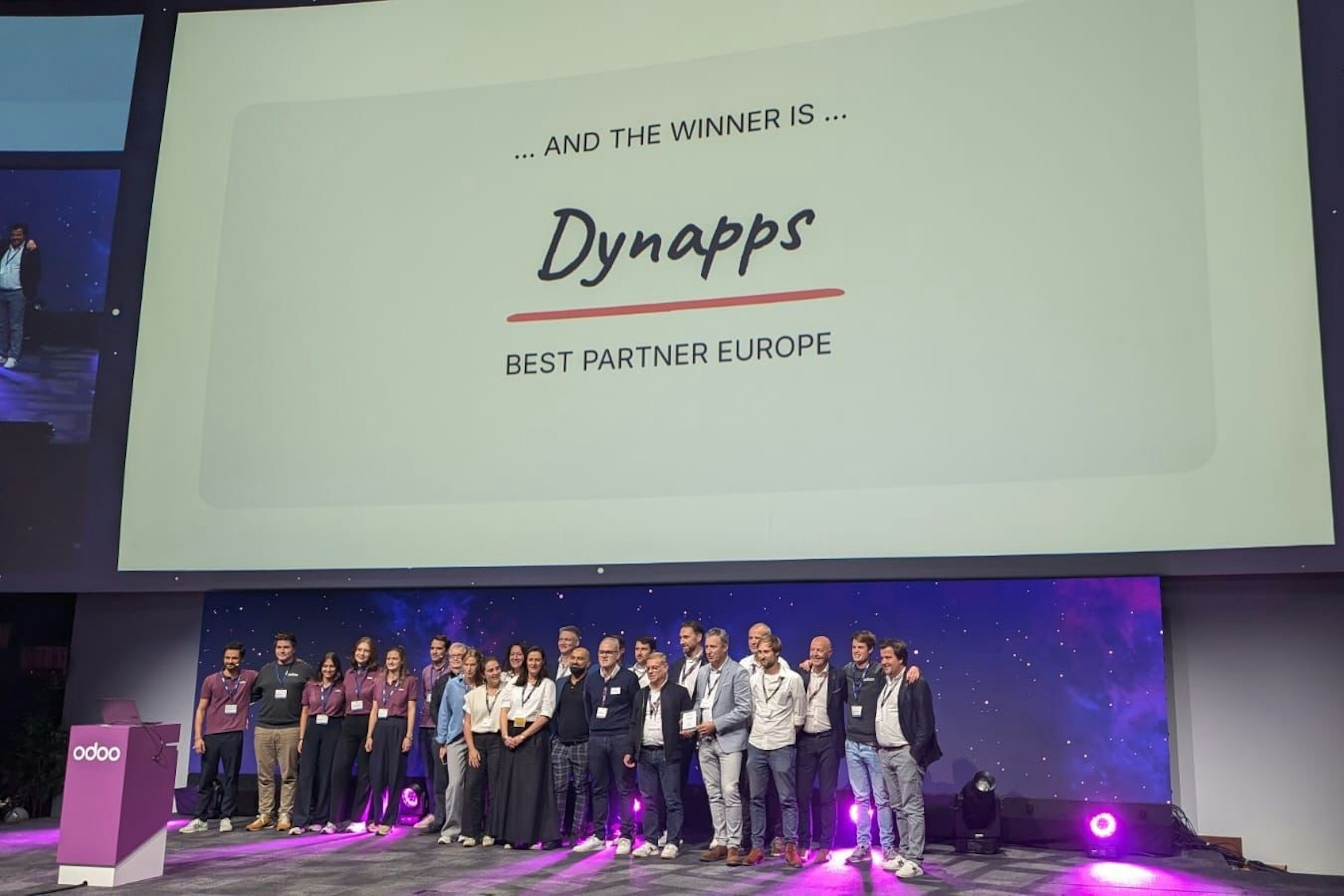
Dynapps named Best Odoo Partner in Europe
At the Odoo Experience Days in Brussels, Dynapps won the title of Best Odoo Implementation Partner in Europe, with former CEO Karel Hendrickx and the team collecting the award on 2–4 October 2024.

3 min read
Dynapps recertified to ISO/IEC 27001:2022 with zero non-conformities
Dynapps holds the ISO/IEC 27001:2022 certificate for its information security management system across its Belgian and Dutch entities. The January 2026 recertification audit closed with zero non-conformities.
4 min read
ERP vs CRM: what is the difference?
In a competitive market, businesses lean on software to operate efficiently. Two systems come up most: ERP and CRM. They serve different purposes, and they often work better together than apart.
4 min read
Odoo vs AFAS: comparing two ERP systems built for SMEs in NL and BE
A side-by-side comparison of Odoo and AFAS, two ERP systems built for SMEs in the Netherlands and Belgium. It weighs flexibility, user-friendliness, support, integrations and cost per system.
7-minute read
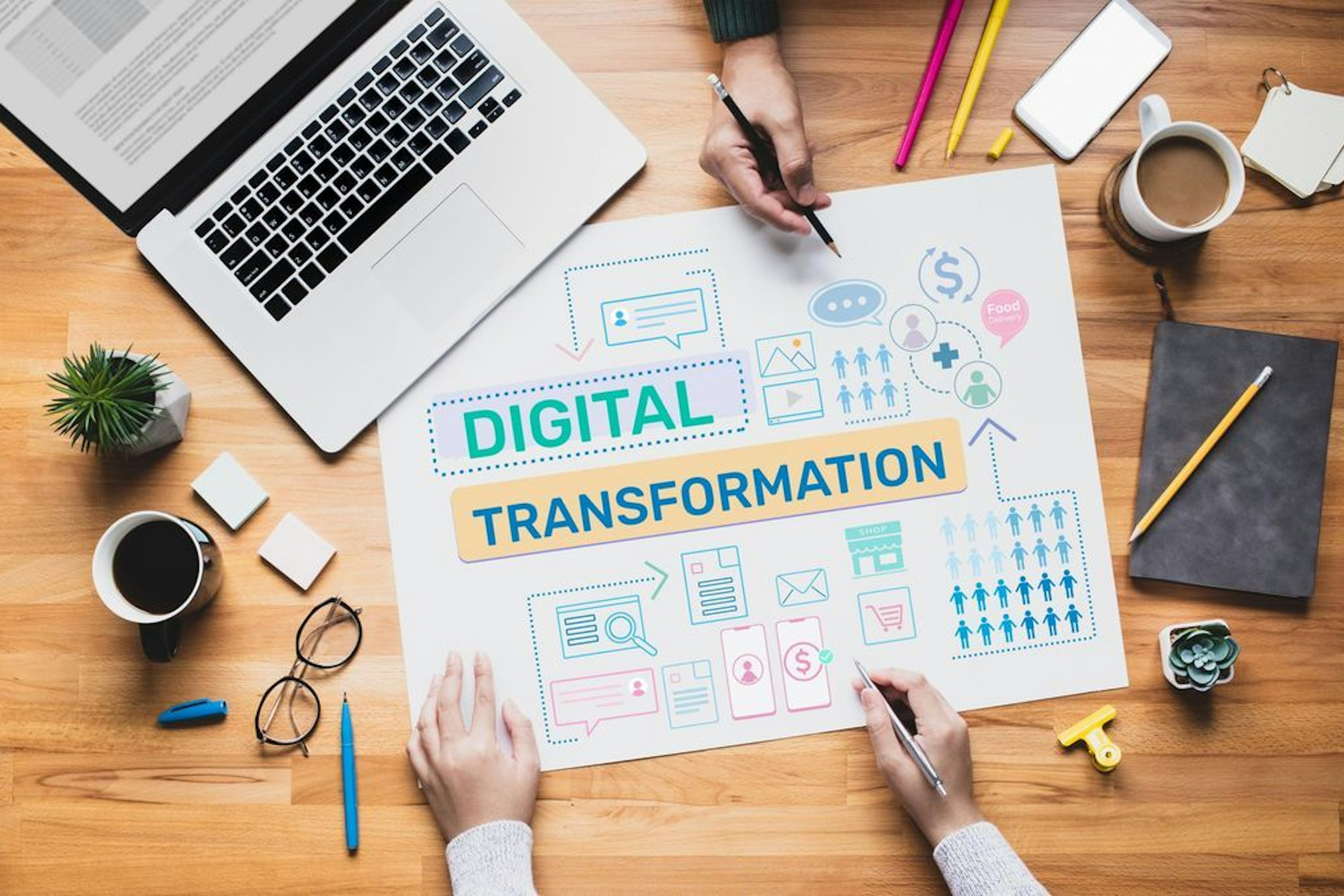
Digital transformation: what it is, and how to actually do it.
Digital transformation is a worn-out phrase. Behind it sits a real question: does your business still run on disconnected tools, manual steps, and spreadsheets nobody fully trusts? This is what digital transformation actually means, why it matters, how to do it step by step, and the mistakes that sink it. Without the buzzwords.

5-minute read
Odoo vs Dolibarr: which ERP fits your business?
Odoo and Dolibarr are both open-source ERPs, but they aim at different companies. Dolibarr keeps things simple for very small organisations. Odoo goes deeper and scales further. Here is a fair comparison, so you can match the tool to where your business is heading.