ERP vs CRM: what is the difference?
In a competitive market, businesses lean on software to operate efficiently. Two systems come up most: ERP and CRM. They serve different purposes, and they often work better together than apart.
What is ERP?
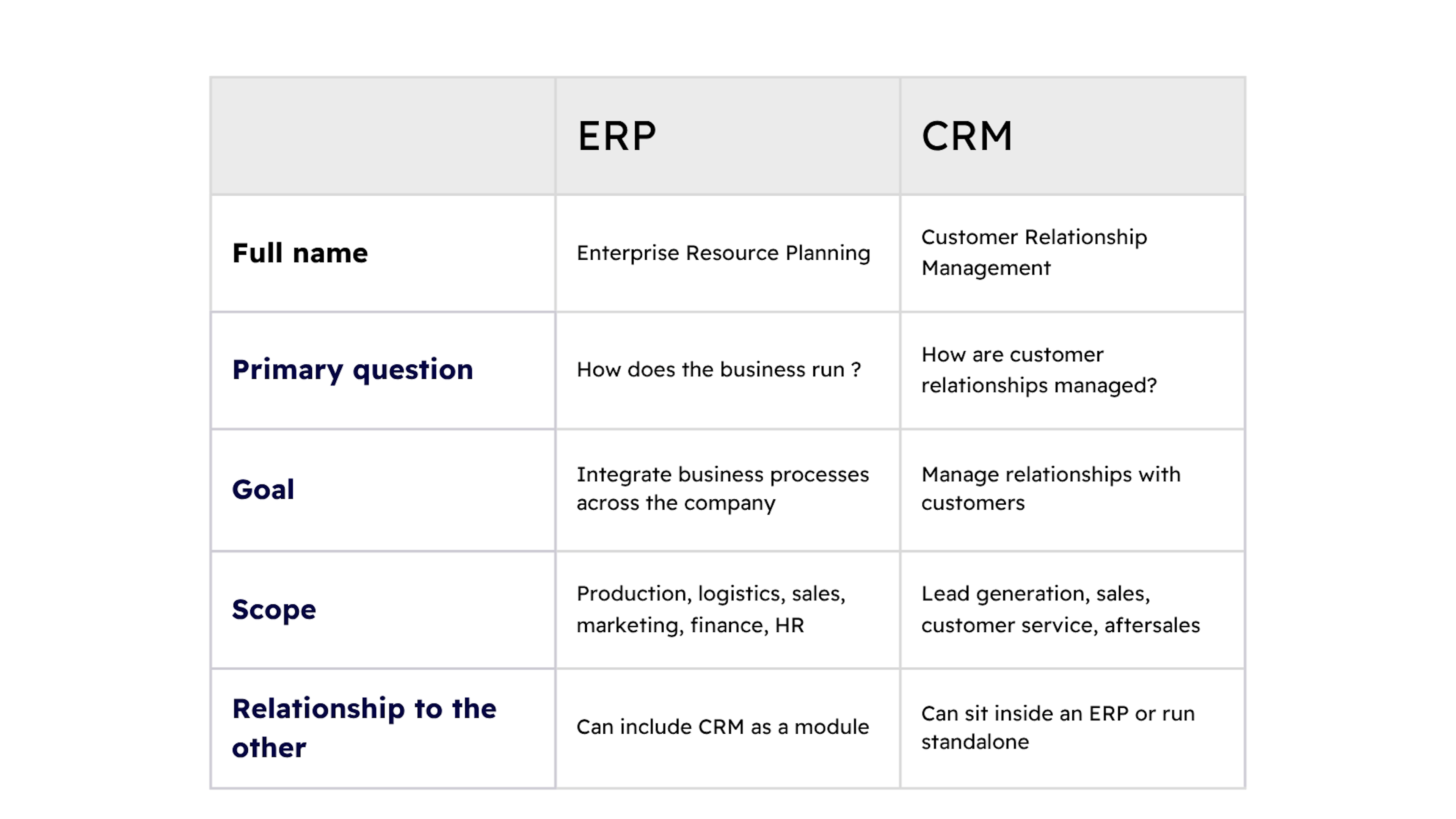
ERP stands for Enterprise Resource Planning. It is a software solution that integrates the business processes of a company, including production, logistics, sales, marketing, finance, and human resources.
The goal of ERP is to work efficiently, avoid double work, and give more insight and oversight across the business. It is a combination of processes and agreements. ERP touches everything inside a company: from production to sales, from purchasing to logistics, from HR to marketing.
What is CRM?
CRM stands for Customer Relationship Management. It is a software solution that helps companies manage their relationships with customers, covering processes like lead generation, sales, customer service, and aftersales.
CRM maps customers and sales. It can sit as part of an ERP system, or it can run on its own.
What is the difference between ERP and CRM?
ERP and CRM are both important tools for companies, but they have different objectives. ERP is built to integrate business processes across the company. CRM is built to manage relationships with customers.
The two systems are often complementary. When companies implement both, they integrate their business processes further and improve their customer relationships at the same time.

When to choose ERP?
Companies should consider ERP when they want to:
Integrate their business processes
Improve their efficiency and effectiveness
Lower their costs
Increase their profitability
An ERP system makes work easier and gives insight and oversight, but it is not a must. Dynapps looks at the possible costs and benefits together with the client, because a good return on investment matters.
What does an ERP system cost?
The cost of an ERP system varies with the size and complexity of the company, the functions of the system, and the supplier. Every company has its own organisation, management culture, and unique selling points, so there is no single answer to what an ERP system costs. The categories of cost can be named.
Direct costs, one-off:
Implementation
Setup costs
Direct costs, recurring:
Licences
Hosting
Indirect costs:
Hardware
Software
About the Odoo ERP system
Odoo is an open source ERP system available to both small and large companies. The platform is built modularly, so companies use only the modules they need. That keeps the system affordable and flexible, without paying for functionality that sits idle.
The module catalogue covers a wide range of business functions, including production, logistics, sales, marketing, finance, and human resources. Companies can start with a few modules and add more as their needs grow.
What sets the platform apart is the release cadence: new features and improvements ship continuously, so the system keeps up with how businesses actually evolve. For companies looking for an affordable, flexible, and evolving ERP, Odoo is a strong fit.
See what Odoo could look like for your business.
A first conversation to see if there is a match, and a demo shaped around your processes.
More posts like this

3-minute read
Interview with Leïla Chojnacki, Deputy CEO and CFO of the Obiz Group
3 min read
Odoo 19.4: What's new? Key features and essential takeaways
Odoo 19.4 (July 2026) is a quarterly update: connection to AI agents via MCP, voice interaction, editable margins, two-tier duplicate detection, stock aging report, and continuous production.
3 minute read
AI in Odoo: What are the requirements for enabling it?
The question "Do we have the right to use Odoo's AI?" often has a simpler answer than expected.

4 min read
Certified by Dynapps: bringing Odoo expertise to local SMEs in France
Dynapps France is rolling out the Certified by Dynapps label, a program that gives small and medium-sized businesses local Odoo expertise and gives independent consultants a structured way to grow around Odoo.
4 min read
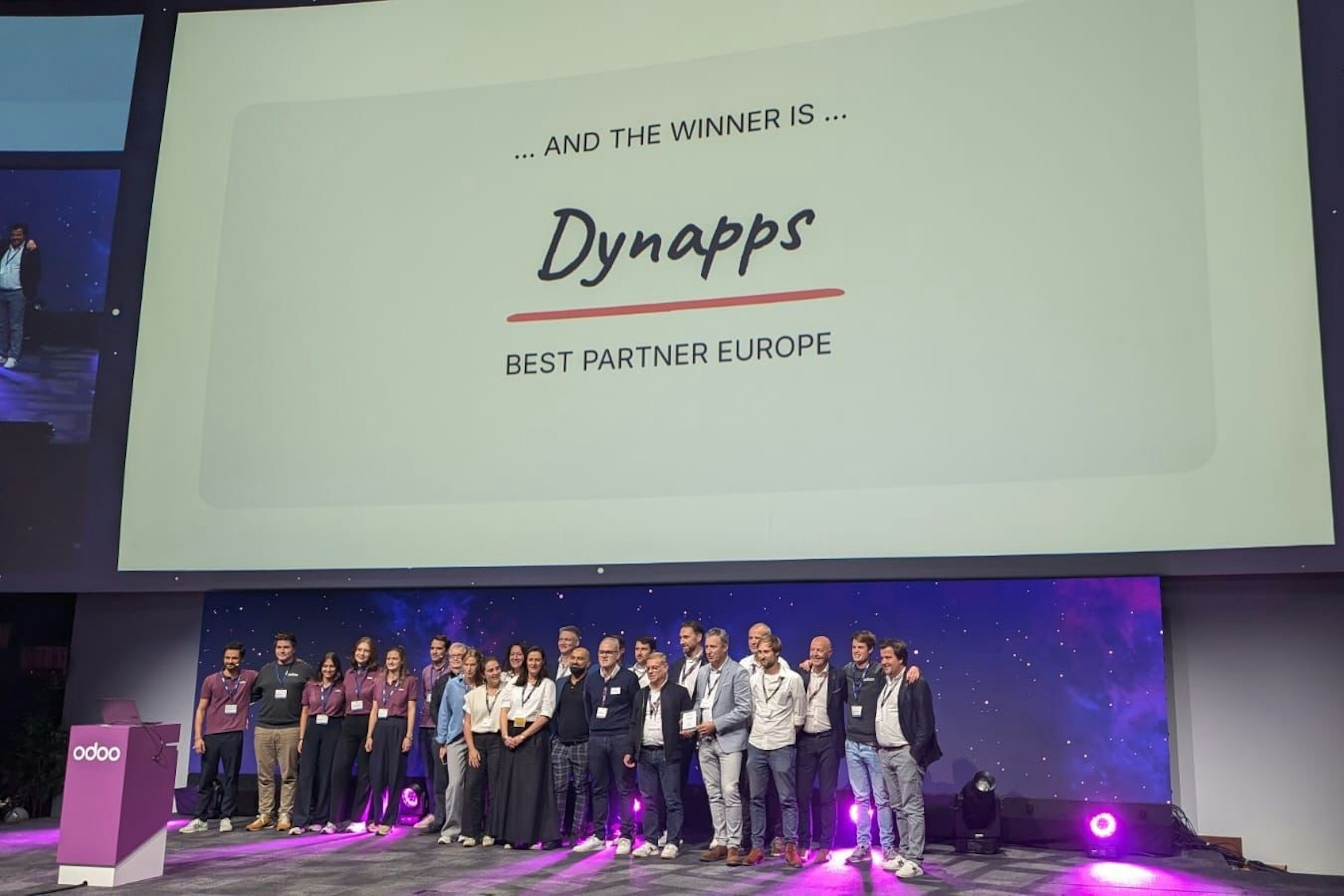
Dynapps named Best Odoo Partner in Europe
At the Odoo Experience Days in Brussels, Dynapps won the title of Best Odoo Implementation Partner in Europe, with former CEO Karel Hendrickx and the team collecting the award on 2–4 October 2024.
3 min read
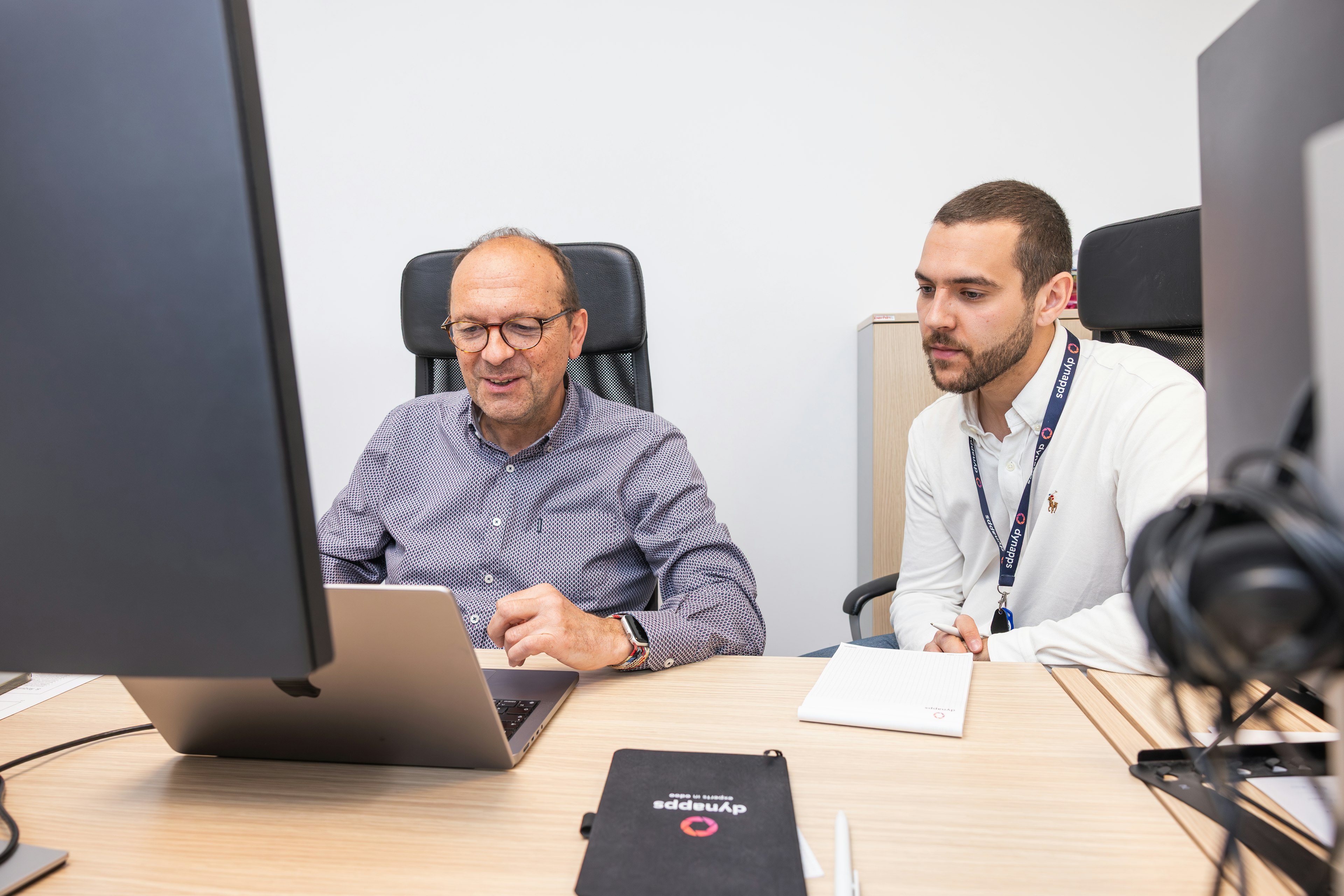
Dynapps recertified to ISO/IEC 27001:2022 with zero non-conformities
Dynapps holds the ISO/IEC 27001:2022 certificate for its information security management system across its Belgian and Dutch entities. The January 2026 recertification audit closed with zero non-conformities.
6 min read
Odoo or Exact: which ERP fits your SME?
Choosing an ERP changes how the business runs. Odoo and Exact both target SMEs, but they solve different problems. This is a side-by-side read on functionality, flexibility, support, and where each one fits.
4 min read
Odoo vs AFAS: comparing two ERP systems built for SMEs in NL and BE
A side-by-side comparison of Odoo and AFAS, two ERP systems built for SMEs in the Netherlands and Belgium. It weighs flexibility, user-friendliness, support, integrations and cost per system.
7-minute read
Digital transformation: what it is, and how to actually do it.
Digital transformation is a worn-out phrase. Behind it sits a real question: does your business still run on disconnected tools, manual steps, and spreadsheets nobody fully trusts? This is what digital transformation actually means, why it matters, how to do it step by step, and the mistakes that sink it. Without the buzzwords.

5-minute read
Odoo vs Dolibarr: which ERP fits your business?
Odoo and Dolibarr are both open-source ERPs, but they aim at different companies. Dolibarr keeps things simple for very small organisations. Odoo goes deeper and scales further. Here is a fair comparison, so you can match the tool to where your business is heading.